
Strait Risk
An Iranian controlled Hormuz is another strike against fossil fuels.

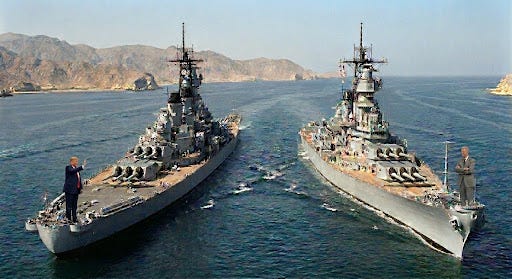
Even as he bellows at Iranian leaders to open the Strait of Hormuz, Donald Trump continues to talk about ending the conflict without freeing the critical waterway from Iran’s control.
That’s an earthquake in geopolitics, and marks an important moment in the energy transition.
Trump’s message gets clearer every day: no longer is the world’s most important fossil-fuel throughway important enough for the world’s most powerful nation to put its navy on the line to keep open. What’s been known for nearly a half century as the Carter Doctrine — President Jimmy Carter’s declaration in 1980 that the U.S. would use military force to keep the strait open — is on life support.
Leaving the strait under Iran’s control would effectively render that commitment mute — opening a new era of uncertainty for the world’s largest single source of oil and gas.
That alone hardly puts the fossil fuel era in the rear view mirror, of course. Coal, oil and, especially, natural gas, will be used well into the future. That’s especially true for the U.S., which has a diverse economy awash in domestic oil, gas and coal resources. For the rest of the world, fossil fuels will continue to come from the Gulf.
Still, a U.S. decision to walk away from assuring the strait is free and open to all would be among the clearest signs yet the long twilight of the fossil fuel era is upon us. It would mark the end of a century and a half when control over access to the world’s biggest source of hydrocarbons has been the sine qua non of superpower dominance.
Imperial Britain controlled the strait through the early years of oil discovery to 1971, when it abandoned the Gulf as its once globe-spanning empire slowly unraveled. The U.S. stepped in. Nine years and two Middle East oil crises later, Carter solidified the U.S. role as guarantor of global energy supplies with his 1980 declaration.
Should Washington bail, do not expect Beijing to step in militarily. As the world’s second largest economy, far and away the largest oil importer and the biggest naval power after the U.S., it might seem the logical inheritor of this geopolitical crown.
But for all its reliance on Gulf oil and gas, China doesn’t see the strait as worth putting the full force of its military on the line to defend. Its goal is to reduce dependence on imported fossil fuels.
If Israeli and U.S. attacks stop with Iran still in control of the shipping lane, some configuration of countries — likely including the U.S. — will step up and negotiate an opening of the strait with the Iranian regime.
This won’t be simple, and presents an existential threat to Arab Gulf monarchies. We’ve looked at how their future depends on using their oil and gas wealth to diversify their economies in freewheeling trade and investment hubs.
U.S. and Israeli bombing of Iran has been sustained and devastating, but as we’ve seen, so far not enough to finish off the Iranian regime. The regime’s new leaders are harder line. An 86-year-old Ayatollah Khamenei has been replaced by his son, a 56-year-old Ayatollah Khamenei. Perhaps this interation of the regime will prove to be more brittle. We’ll see how the new bosses fare with the long-suffering Iranian people once the fighting stops and they try to explain what just happened.
But when it comes to dealing with the outside world, the regime still holds two strong cards: a stockpile of near-bomb-grade nuclear fuel and control over the strait.
It views the combination as a path out of the current crisis.
It likely sees a nuclear bomb as its best bet for long term security, a la North Korea. Regime leaders won’t give it up.
Israel won’t accept that. Nor very likely will the U.S.
Bombings, assassinations, attempts to overthrow the regime will continue. Until the regime builds a nuclear weapon, its main tool to counter such attacks will remain implicit control over the strait. It is already institutionalizing this control, picking and choosing which ships can pass and charging a toll for the privilege.
All this is a recipe for a chronically volatile Gulf — one with higher shipping and insurance costs, persistently higher prices, and the constant threat of violent interruption.
All will provide ongoing incentives for importing countries to not only diversify where they get their oil and gas from, but also seek durable alternatives.
This will accelerate the transformation of energy systems — converting transportation and heating systems to electricity and building secure domestic capacity to provide that electricity. At first, more coal will be burned, especially in Asia. But the combination of renewables and batteries — already growing fast — is now cheaper and more sustainable than coal in most places.
These will gain even more momentum.
A global order underpinned by free and easy access to hydrocarbons everywhere and at all times is coming to an end.
We have already already entered a complicated middle stage of the energy transition, one marked confusing cross-currents and seeming contradictions.
What’s clear is that security will become paramount.
A chronically turbulent Gulf under the thumb of Iran will only underscore the insecurity of the strait.
Korea imports 100% of its oil and LNG. Hormuz isn’t an abstract risk there. The president has been pushing to accelerate the energy transition, and today the Ministry of Climate, Energy and Environment reported a concrete plan: 20%+ renewables by 2030, electrification across transport and heating, restructured power market.
Korea already generates 31% from nuclear. The goal is to cut import dependence before the next crisis. Your thesis is playing out in real time.