This post continues our look at the proposed merger of NextEra Energy and Dominion Energy to form the country’s largest power company.
Please read the earlier posts if you haven’t yet. They build on each other:
We’ve looked at the importance of electricity in the future of energy and the energy transition. We’ve looked at the complexity of the current moment in the U.S. electricity system.
We’ve traced the history of NextEra’s core regulated utility business, the company’s Florida Power & Light division, to help understand how the monopoly came into being, why, at times, it’s been able to meet growing demand for electricity while pushing down the price of power — or at least keeping it in check — and why, at other times, it has not. We’ve traced the history of Dominion, especially the humongous role data centers have played in the company’s growth — and attracting the covetous eye of NextEra.
Finally, we’ve noted the grassroots political firestorm that’s broken out around data centers, which produce and process artificial intelligence, how governors have wound up at the center of this firestorm, and how Virginia Governor Abigail Spanberger has been thrust uniquely into the nexus of AI, energy and national politics.
Now, the grid.
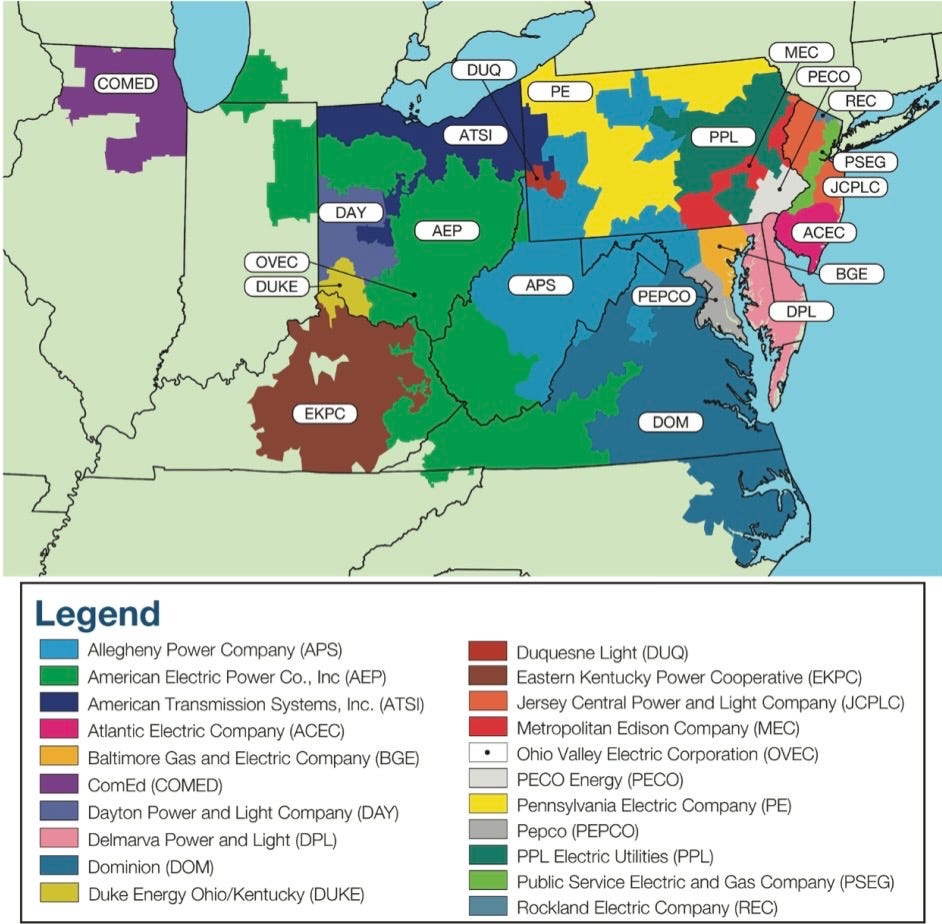
Here we come to the belly of the beast, the transmission system that makes it work — or not. That would be PJM Interconnection L.L.C. in the case of Virginia and parts of twelve other states.
Created in 1927 by Pennsylvania, New Jersey and Maryland — hence the (sort of) initials by which it’s known — PJM operates the electricity grid for 67 million people across a huge swath of America, from northern Illinois to the mid-Atlantic coast as far south as parts of North Carolina.
PJM is one of seven such organizations in the U.S. going by an alphabet soup of names: CAISO (California Independent System Operator), ERCOT (Electric Reliability Council of Texas), ISO-NE (Independent System Operator — Northeast), MISO (Midcontinent Independent System Operator), NYISO (New York Independent System Operator) and SPP (Southwest Power Protocol).
Inscrutable as these may sound, arcane though they may be, the largest economy in the world wholly depends on them to keep the lights on, the factory floors humming and, increasingly, the data moving. PJM alone controls more than 88,000 miles of transmission lines — enough to easily circle the globe three times — that criss-cross 368,000 square miles, an area almost twice the size of Spain.
Electricity grids are the largest machines humans have ever built, and operating one is daunting. Supply of electricity must exactly meet demand continuously. This requires constant adjustments across the network in real time. Just as challenging, future demand must be accurately predicted minutes, hours, days, months, and even years ahead to assure the capacity is there to meet it.
What failure looks like is what Spain experienced last year: a nationwide blackout triggered by catastrophic, cascading grid collapse after one small portion got out of balance. Or what PJM itself experienced — less catastrophically, but frighteningly nonetheless — earlier this year when a single transmission line failure in northern Virginia tripped up the entire PJM network from Chicago to Washington D.C.
Incidents like these endanger lives.
Air conditioners and heating stop at the worst possible time, hospitals go off-line, people get burned trying to use candles for light and gas stoves for heat.
More recently, electricity consumers in PJM have been subjected to another slow-motion failure of the grid as it’s been unable to meet growth of demand, mostly from data centers
The problem has been particularly acute in Virginia. But it threatens to spread across PJM as new data center projects have proliferated across Indiana, Ohio and Pennsylvania.
Utilities and developers have lined up to build new power generation plants, including solar arrays, wind farms and natural gas plants.
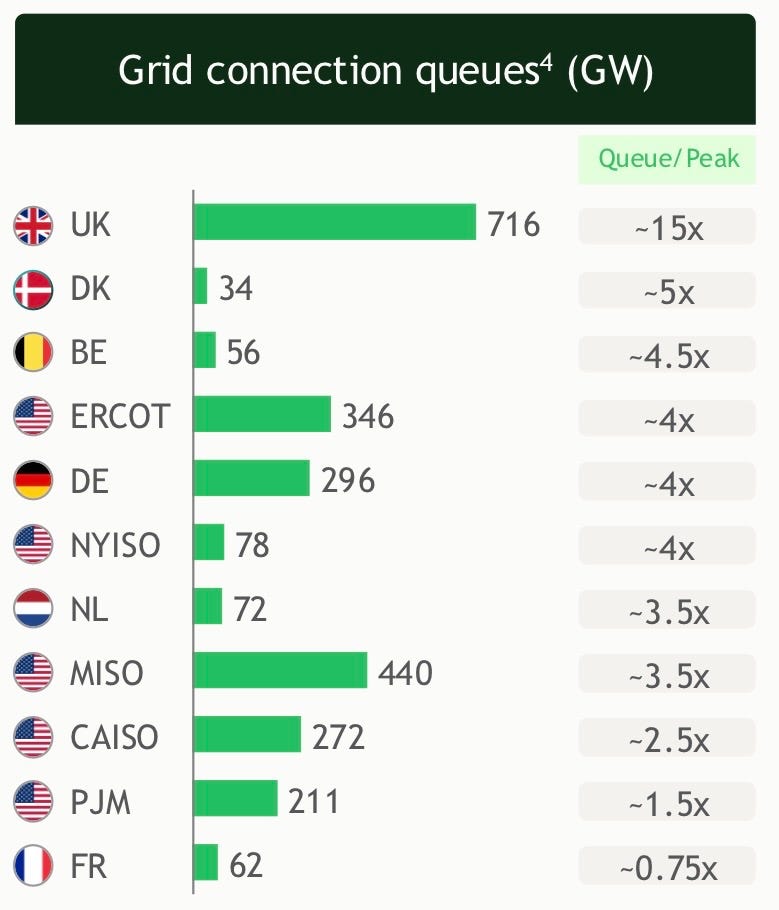
Projects that want to sell power into the grid apply for PJM’s permission to connect. But each new proposed connection must be studied to assure the new load won’t throw the whole system out of balance. PJM’s thorough but slow moving study process hasn’t been able to keep up.
Where studies get completed, many of the projects require new or replacement transmission lines and additional power substations. These can take years to build, and they are expensive.
Some developers are perfectly willing to pay these themselves. But the delays drive up costs. Many wind up cancelling their projects.
In Virginia, where electricity demand is growing fastest at more than 6% a year, the problem has been acute. A study by the Natural Resources Defense Council, an environmental group, found that 103 power plants in the state have withdrawn or been delayed by network upgrade bottlenecks.
That means enough electricity to power about 7.5 million homes (10,000 megawatts) didn’t get built, with another dollop sufficient to power more about 3 million homes delayed until at least 2030, the NRDC said.
With electricity demand growing fast and the supply of electricity expanding sluggishly at best, the price of electricity in PJM has soared.
“The price impacts on customers have been very large and are not reversible,” as an independent analysis by a company assigned to monitor PJM recently concluded.
Additional data center demand forcing prices higher increased PJM customer bills by $13.7 billion. The rise would have been double that had PJM not agreed, under pressure from furious state governors, to cap the amount it would pay to assure new power would come on line.
But capping its outlays also left PJM far short of the power it needs to ward off blackouts when electricity use surges towards system limits. Every heat wave and cold snap has become a nail-biter for the grid operator, and every customer, at least those bothering to try to track the situation.
Virginia and its dominant utility, Dominion Energy, hasn’t stopped building new power generation, or trying to build even more.
The next post will look at that effort — how it’s changing, why it’s coming up short.