Powering Up
Electricity is a growth story. Florida got in on the ground floor.

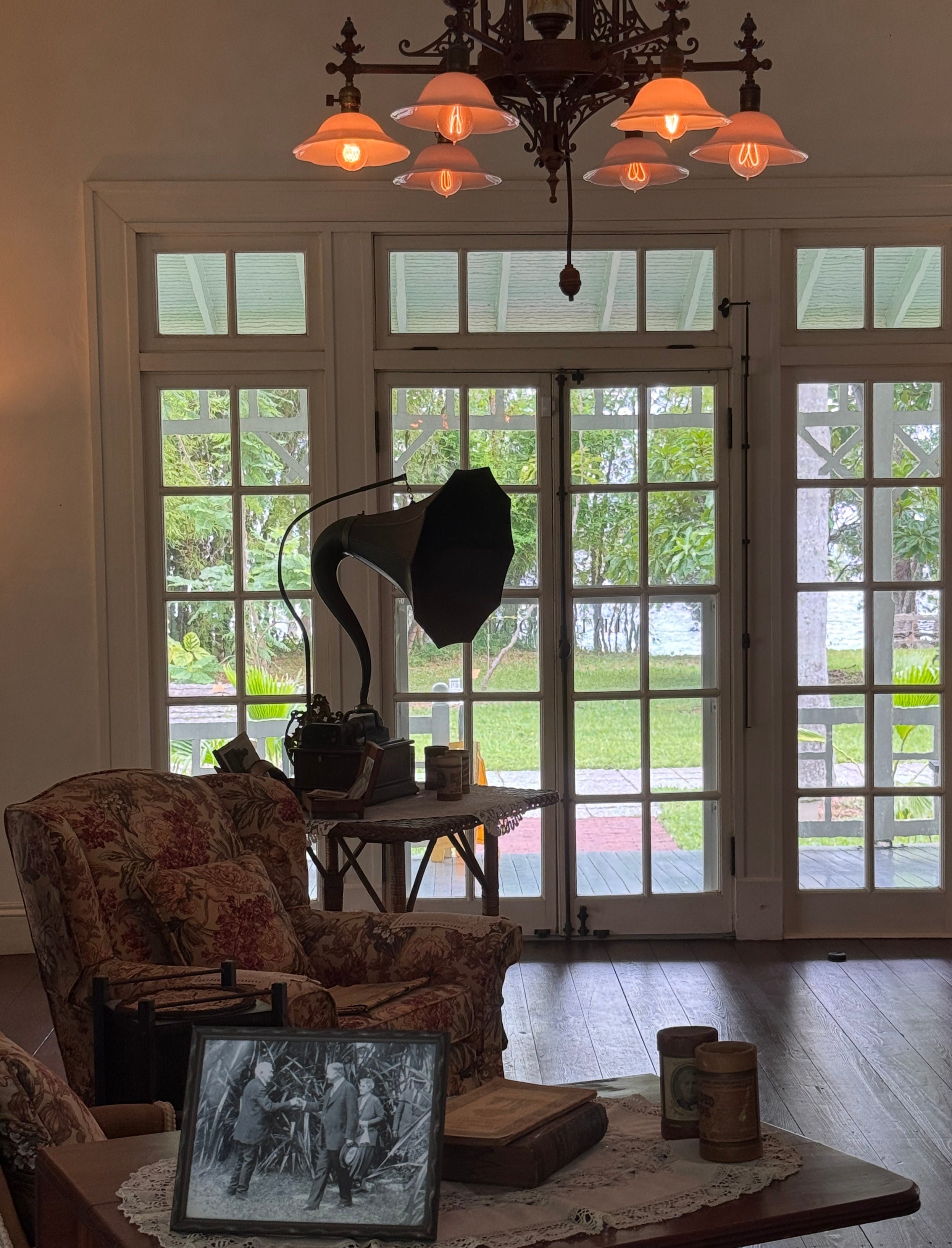
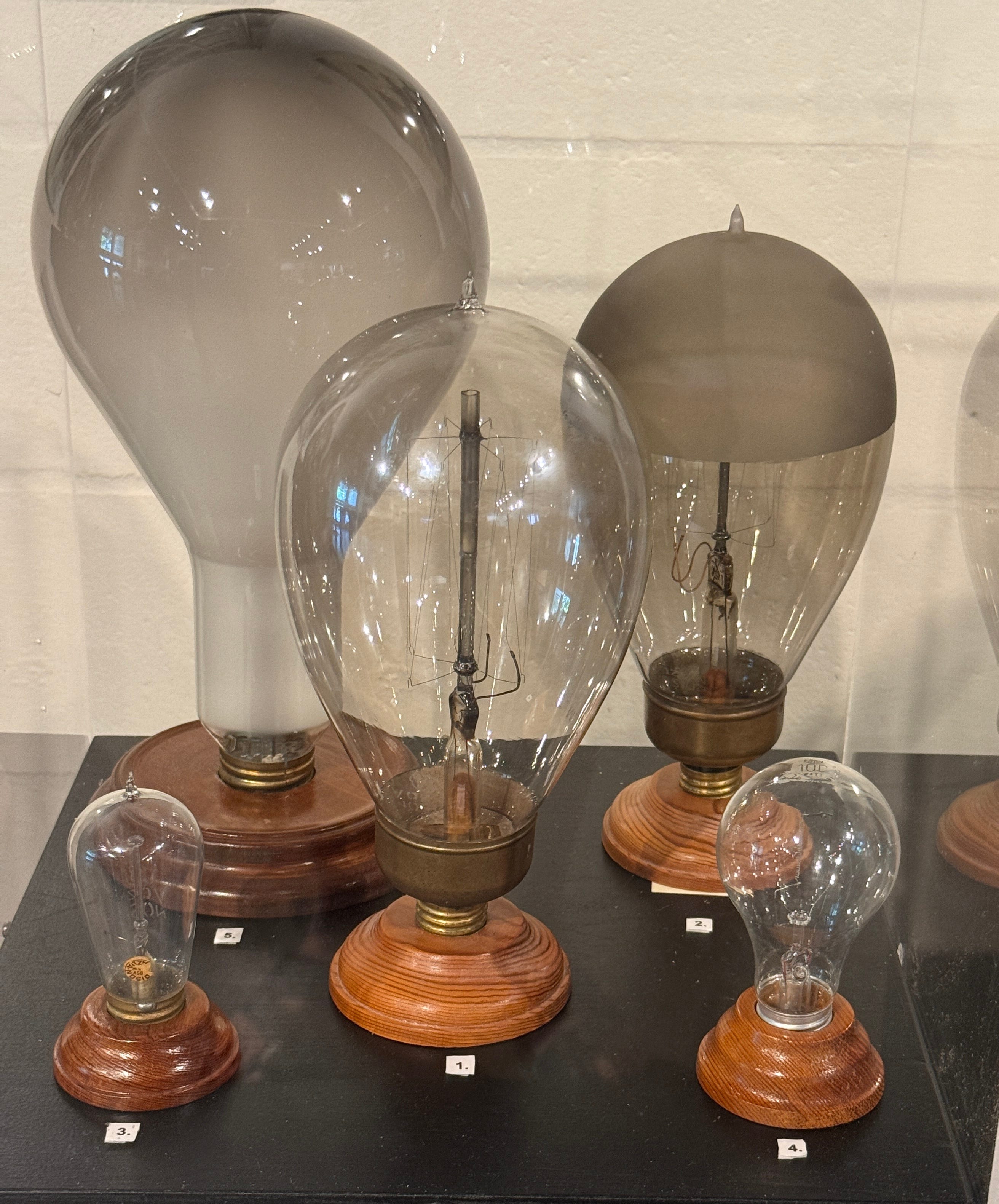
Here at his Seminole Lodge winter estate in Fort Myers, Thomas Edison turned on the first light bulb to be found in southern Florida in 1887.
Five years earlier, Edison had started the world’s first commercial electricity generation plant in New York City. Incandescent lighting, which Edison invented, was among the first great uses of that electricity.
The inventor was growing wealthy as the combination of electricity and light bulbs spread around the country.
At dusk on New Year’s Eve of 1898, not far from the Edison winter estate, the Seminole Power Company lit up First Street in Fort Myers. The company was owned by local entrepreneur Albertus A. “Bertie” Gardner.
A few years later, Gardner started selling ice — another early use for electricity. He renamed the business the Seminole Power & Ice Company. More growth, more name changes, and new owners followed. In 1925, the company was consolidated with other lighting, ice and power companies to form the Florida Power & Light Company.
Eventually, FPL acquired some 6 million customers across much of Florida. The utility is now part of NextEra Energy, an even larger company that produces and sells energy across the country. NextEra now wants to become larger still, by purchasing another large utility, Dominion Energy, which has some 4 million customers in Virginia, North Carolina and South Carolina.
The proposed merger, which would create the largest utility in America, is a window on some of the biggest forces shaping energy use today, especially the growth of artificial intelligence. These include who wins and who loses the AI race, who pays for and who profits from an expected tidal wave of electricity use, and who winds up holding the bag if the expected tsunami falls to materialize.
The history and operations of Florida Power & Light are central to these questions because utilities are the corporate medium through which the boom will largely play out. How they make money — especially the regulated utility business model most follow — is the core of the NextEra-Dominion merger’s logic.
These two company histories and their operations are complicated. But they’re worth understanding. How a still-larger merged company would behave helps answer the biggest question: Can we muster the energy needed for artificial intelligence — whatever that turns out to mean in the end — while keeping the cost of electricity affordable for everything else?
FPL grew through the first third of the last century, plugging in homes, businesses and cities along with the rest of the power industry. Between the companies, customers, government and courts, it was collectively decided that a repeat of the turbulent, pell-mell expansion of railroads over the past three decades was undesirable.
Rather than competing, electricity companies would be granted monopolies from the get-go. Companies such as FPL would receive exclusive territories shielded from competition. This would spare communities the turbulence and inefficiency of multiple companies stringing spiderwebs of duplicative electric lines from power generators to homes.
Of course, governments understood the consequence for both consumers and suppliers of electricity: with no alternative to the territorial provider, there would be no competition on price. Consumers would have no alternatives to choose from; utilities could set prices without fear of competition.
Thus, governments created oversight boards to review and approve how much utilities could charge customers. The utilities would receive a guaranteed profit above the cost incurred to build new generation and run the system.
This system worked while the industry grew rapidly, especially in places like Florida where the population and economy expanded by leaps and bounds. The cost of power plants and stringing lines was covered by selling more power. Utilities served their customers, pocketed a sure-fire profit, and drove down the cost of each kilowatt of electricity all at the same time. Lower power costs created more demand, another turn of the profit wheel.
This flywheel hit problems starting in the 1970s, as the cost of the fuel to make electricity — largely oil at the time — skyrocketed during the Middle East oil crises of 1973 and 1979.
Demand tailed off, though less so in Florida, where the population continued to grow. The virtual cycle petered out in most of the country.
A burst of nuclear power raised hopes of a new power source “too cheap to meter.” But the cost of building nuclear plants, and eventually safety concerns, eventually forced consumer rates higher. Energy efficiency — spurred by the need for cost savings — eventually offset growing population and economic activity. Utilities became the epitome of boring, steady businesses for most of the 1980s.
Except that the price of electricity continued to rise, even in fast growing Florida. That was partly because utilities got better at influencing the regulators who oversaw them, allowing more profit to flow to shareholders. With little need to build, they boosted earnings by spending less on operations, upkeep and maintenance they weren’t allowed to profit from.
This set the stage for experiments deregulating the energy sector in the 1990s. Some states, such as California and Texas, encouraged other companies besides utilities to produce electricity and sell it competitively.
Many east coast states, including those where FPL and Dominion operated, kept the monopoly regulated utility model. FPL, though, saw the deregulation elsewhere as an opportunity. The company began building and selling generation across the country, eventually forming a holding company, NextEra Energy, to contain the two business strategies under one corporate roof.
But where NextEra’s unregulated side became a freewheeling engine of growth — turning itself into one of the biggest builders of wind and solar power in places like Texas where competition flourished — the company’s regulated business largely remained a staid utility.
Which is to say, predictably profitable.
Indeed, FPL got regulators to sign onto what critics called the country’s highest guaranteed profit margins, even while lagging in building solar power in the Sunshine State for many years. FPL collected $18.262 billion last year in revenue and pocketed 27.4 percent as corporate profit. The profit portion of the bills that FPL customers pay was higher than any of the 78 other electric utilities surveyed by the Energy and Policy Institute (EPI).
To help with that, NextEra has been among the largest contributors to the Florida politicians responsible for appointing members to the regulatory board that determines how much the company can charge customers and the profit guaranteed for its shareholders. The company gave $1.9 million to federal campaigns in 2023 and 2024, more than any other investor-owned utility company, according to Open Secrets, a nonprofit that tracks money in politics.
NextEra has scanned the horizon in recent years for other places to apply its prowess in regulated markets.
An attempt to buy a regulated utility in Jacksonville, Florida ended amid a swirl of press reports, complaints and a lawsuit claiming the company tried to manipulate local elections and surveilled a journalist covering the company. Without admitting wrongdoing, NextEra, after announcing its bid for Dominion, agreed to pay $150 million to settle the suit.
NextEra also made attempts to purchase regulated utilities in Hawaii and Texas that were rejected by local regulators in 2016 and 2017.
Then came the data center boom. Now NextEra has its sights on Dominion, whose history we’ll look at in my next post.