
Dire Strait
In Houston this week, the energy world is reckoning with a lot.

America’s largest conference of oil and gas executives doesn’t get planned overnight. A global energy crisis, on the other hand, can unfold in a heartbeat, particularly when it involves the most critical chokepoint for oil and gas flows on the planet.
This week I’m attending CERAWeek by S&P Global in America’s energy capital of Houston. The event is the oil and gas industry’s biggest annual corporate jamboree.
This year executives and analysts have found themselves caught between two realities: one that existed when most of the planning for the event took place through the past year, another rapidly setting in as the scale, implications, and intractability of the current crisis in the Strait of Hormuz becomes clearer.
It’s created an odd vibe here at Houston’s largest conference and convention center.
One minute attendees are gathering in ornate ballrooms to applaud America’s recent rags to riches energy journey. The industry worked hard to deliver this and has every reason to celebrate. Alarmingly dependent on energy imports a decade ago, the U.S. is now a powerhouse exporter of oil and gas.
In a session on drilling and production prospects, executives gushed over the innovation and ingenuity that have coaxed ever more hydrocarbons not from traditional fluid reservoirs but from solid rock in places like Texas’ Permian Basin.
They saw no reason the growth couldn’t continue indefinitely, despite less can-do conventional assessments that U.S. crude production has probably peaked, or soon will.
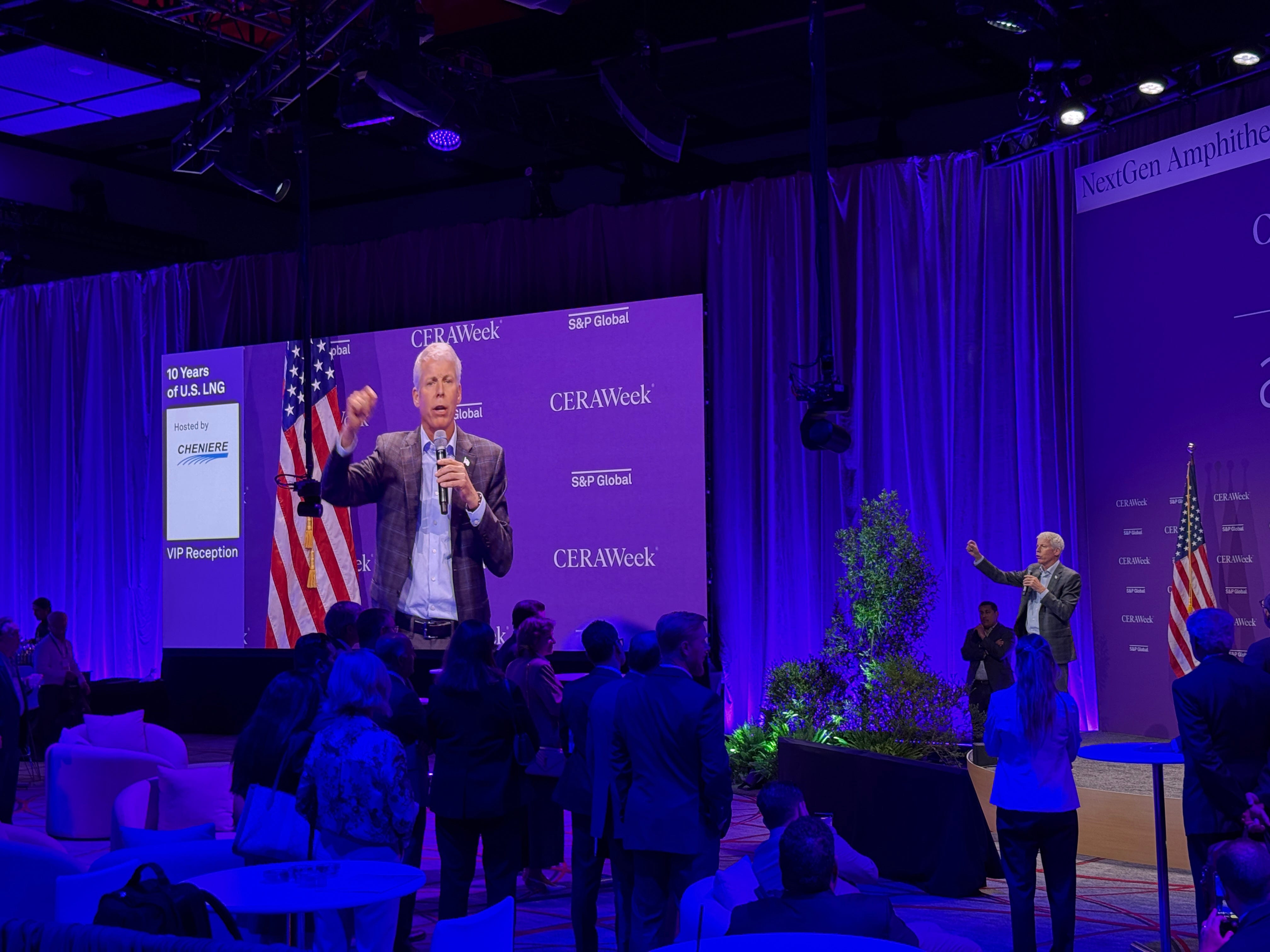
At an evening reception, Secretary of Energy Chris Wright — who participated in that revolution as founder of an oil services business — raised a glass to a pioneering U.S. company.
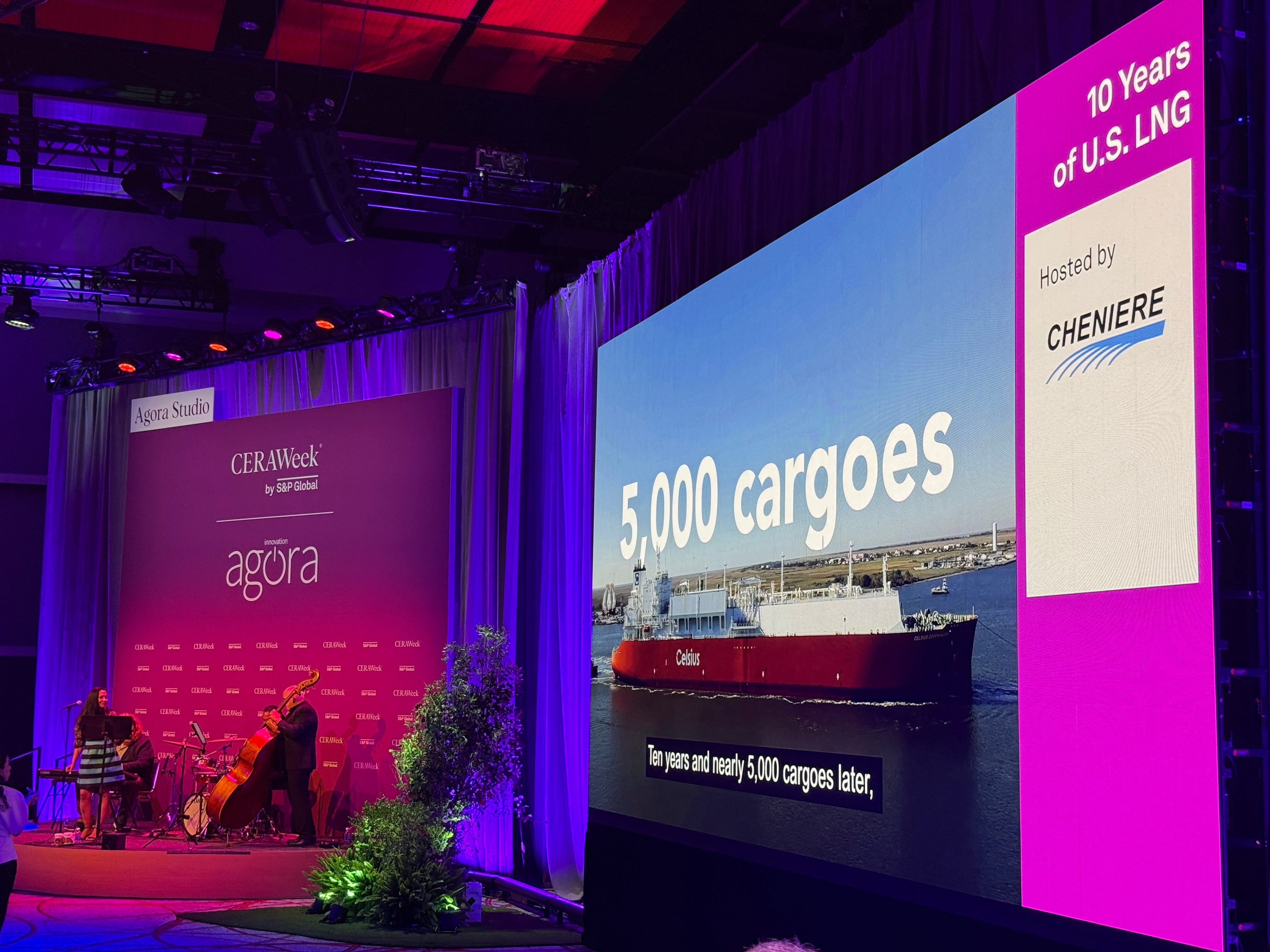
A decade ago, Cheniere finished a historic pivot from importing chilled natural gas when it launched its first export shipment. The liquified gas, better known as LNG, has since become a mainstay of global energy and the U.S. economy. U.S. LNG outright saved Europe when Russia invaded Ukraine and the E.U. suddenly needed a new source of natural gas to replace what was coming from Russia.
At the reception — as attendees dug into a buffet of crawfish sliders, Louisiana jambalaya and spiced pork belly pralines — Wright predicted still greater growth for the industry.
Yet Iran’s closure of the Strait of Hormuz — through which a fifth of the world’s oil and LNG normally flows — has also injected a disorienting uncertainty into this year’s gathering.
By the conference’s third day, Martin Houston, a long time leader in the LNG industry whose last name seems appropriate as an oracle for the gathered oil and gas executives, opened one session like this:
“A lot has been said in a lot of panels over the past few days. I’m going to try to say something a little different. Nothing’s going to be the same from now on in this industry. A red line has been crossed. We need to remember that. A Sword of Damocles will sit above the Strait for some time, maybe a very long time…This is a war that is quite different than many we’ve seen, where we can sit back, watch it on TV, not really care about it. This is affecting everybody.”
But how, exactly, will the industry and the world be affected? What will prove to be the lessons of a crisis that may only be in its beginning stages:
Will Iran’s closure of the strait ultimately underscore for Americans and the world the importance of U.S. energy resources, what the Trump administration trumpets as “energy dominance,” in a chaotic world?
Or will the crisis serve to warn of the inherent vulnerabilities of all energy resources that require shipping across seas and over borders— particularly those resources burnished and wielded as weapons of political dominance?
Houston (the LNG executive-oracle), joined nearly all the LNG industry leaders in concluding that in the end the global gas industry benefits from the turmoil. He noted several new American LNG projects he’d never even heard of before now ready to go ahead and build new export plants
Others see a prolonged crisis looming that could tilt the global energy landscape decisively towards more local, secure energy sources that can be built and controlled within countries. Ones that cannot be easily disrupted by trade battles or military conflicts.
For many countries that means burning more coal for longer, especially those in Asia with their own reserves. Longer term, it means more electric vehicles, more solar and wind generation, more nuclear plants.
Should the Strait of Hormuz remain largely closed, then something like 10-20 million barrels per day of crude oil won’t reach global markets and won’t be used, said Jeff Currie, a legendary commodities analyst now with Carlyle Group, one of the world’s biggest private equity funds.
“We’re going to have energy transition forced upon us in a very painful way,” he told one session, raising eyebrows. “And it’s going to happen very quickly.”

The “who benefits” debate here is framed entirely from the exporter side — U.S. LNG growth vs. forced energy transition. But the most immediate stress test is playing out in importing countries. Korea gets over 99% of its crude and a third of its LNG through or near the Strait. The real transmission channel isn’t physical shortage — Korea holds ~40 days of LNG inventory. It’s price. Higher spot LNG flows directly into the wholesale electricity price through the cost-based pool, and KEPCO absorbs the gap because retail tariffs are politically frozen. The 2022 precedent cost the utility over $30 billion in cumulative operating losses. Hormuz reopening doesn’t erase that structural vulnerability — it just resets the clock.