This post continues our look at the proposed merger of NextEra Energy and Dominion Energy to form the country’s largest power company.
Please read the earlier posts if you haven’t yet. They build on each other:
We’ve looked at the importance of electricity in the future of energy and the energy transition. We’ve looked at the complexity of the current moment in the U.S. electricity system. We’ve traced the history of NextEra’s core regulated utility business, the company’s Florida Power & Light division, to understand how the monopoly came into being, why, at times, it’s been able to meet growing demand for electricity while pushing down the price of power — or at least keeping it in check — and why, at other times, it has not. And we’ve traced the history of Dominion, especially the humongous role data centers have played in the company’s growth — and attracting the covetous eye of NextEra.
This post looks at the maelstrom that data centers and artificial intelligence have created in politics and society. The NextEra-Dominion merger is being sucked in, along with the broader energy transition.
Before going back into Virginia, note what just happened in Pike County, Ohio.
A rural enclave south of the state capital, the area is a bit like northern Virginia when data centers began sprouting there. They started slowly in Virginia and grew steadily. In Pike County, they’ve arrived with a big bang, or, more accurately, it has.
A single colossal new data center is planned there, the work of a trio of companies — the artificial intelligence pioneer OpenAI, semiconductor chip developer Nvidia, and Japanese compute infrastructure builder SB Energy.
This one data center could eventually use as much power as all of New York City, and is expected to cost $500 billion to build. The first stage is planned for 4 gigawatts, as large as all of northern Virginia’s existing data centers combined. Ultimately, the complex is slated for double that.
The day after the project was unveiled, the National Republican Senatorial Committee fired off an internal memo calling data centers a “toxic brand.”
The group, which works to elect Republicans, explained that the data center issue could determine who becomes the state’s next U.S. senator. Democrat Sharrod Brown, a fierce data center opponent, is running against Republican Jon Husted, who favors data center development with conditions.
Their race is one of a handful that will decide control of the chamber overall this fall.
Brown, the NRSC noted with alarm, has turned data centers into an “anchor hanging around Husted’s neck.”
What does any of this have to do with Virginia and the proposed NextEra-Dominion merger?
Data center politics have gone national and turned brutal. The stakes couldn’t be higher.
”If voters’ perceptions of data centers are not fixed quickly, the campaign against them will expand far beyond Ohio,” the group warned.
In many ways it already has. Old-fashioned, not-in-my-backyard obstructionism has dovetailed with anxiety over artificial intelligence and grassroots anger with Big Tech.
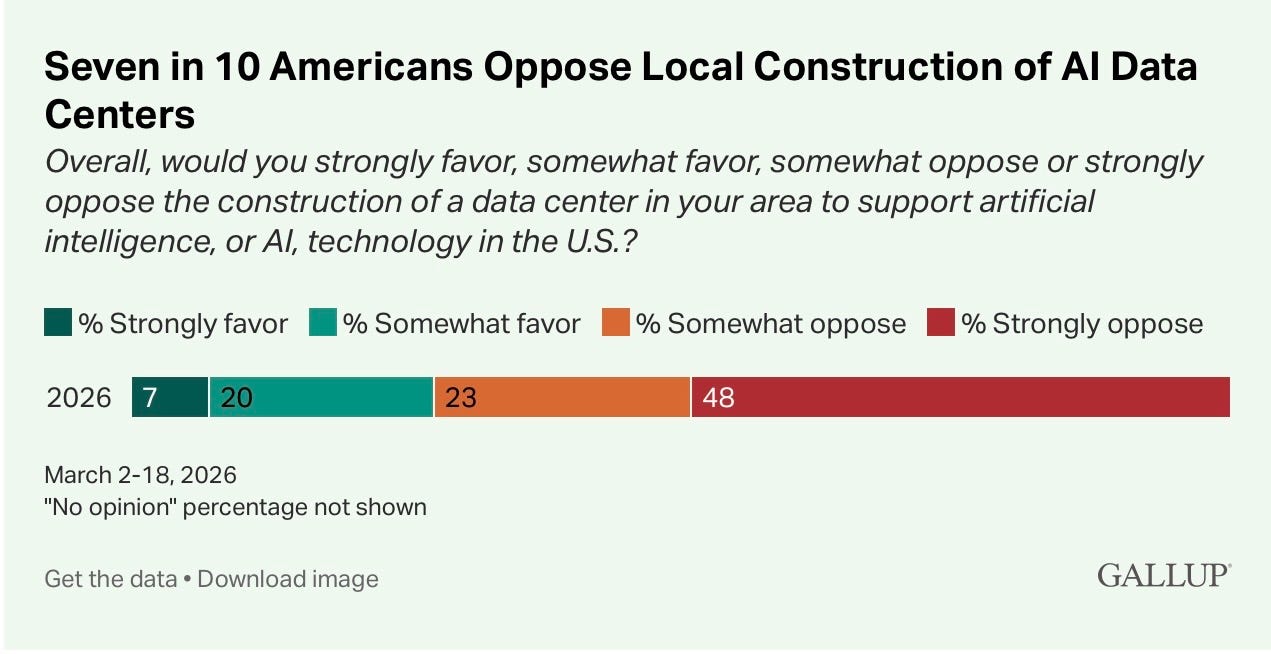
The results of a recent Gallup poll put it starkly: “Seven in 10 Americans oppose constructing data centers for artificial intelligence in their local area, including nearly half, 48%, who are strongly opposed. Barely a quarter favor these projects, with 7% strongly in favor.”
Here at The Energy Adventure(r), we wondered about a backlash brewing during our data center tour at the beginning of the year, when we visited projects in Memphis, Tennessee, Richland Parish, Louisiana, Abilene, Texas and Amarillo, Texas.
What has not occurred — surprisingly given the Ohio Senate race, the Trump administration’s vocal support for artificial intelligence, and the overall drift of national politics — is full-on partisan polarization of the issue.
Politicians of all stripes are moving against data centers. Conservative Florida Gov. Ron DeSantis has bashed them. Progressive liberal Senate candidate Abdul El-Seyed in Michigan opposes them. Democrat Gov. Kathy Hochul in New York and Republican Gov. Greg Abbott in Texas have both paused data center approvals.
Virginia’s governor, Abigail Spanberger, is a staunchly moderate Democrat sometimes talked about as a possible presidential contender in 2028. She’s taking a different tack, one that runs directly through the NextEra-Dominion merger.
Spanberger has been sensitive to rising anger over data centers in the state, where a handful of new projects have already been derailed by grassroots opposition.
She’s stuck up for communities that decide data centers aren’t for them. At the same time, the former CIA agent and U.S. Representative has argued that “walking away from the table” with a moratorium on data center development would hurt the economy and endanger national security.
She says she wants to protect households from higher electricity bills, working with the Virginia legislature to require data centers to pay for all of the system upgrades needed for their power.
Even more assertively, she’s inserted her office into the state approval process for the NextEra-Dominion merger, which formally does not directly involve the governor. The Virginia State Corporation Commission, an independent three-person board appointed by the state legislature atop a professional staff of 750, is the body charged with giving NextEra’s Dominion purchase the thumbs up or thumbs down.
Acknowledging she can’t “make the SCC’s decision for it,” Spanberger says she will advocate for state billpayers and Dominion’s Virginia employees, as well as assess whether the combined company can meet ambitious clean energy requirements enshrined in state law.
With that, she has put herself squarely at the nexus of artificial intelligence, energy, and national politics — perhaps more so than any one individual in the country.
To understand what this means, and the complicated battles now breaking out across all these fronts, there is one other arcane but critically important entity to consider.
The Pennsylvania-New Jersey-Maryland Regional Transmission Organization, better known as PJM, is the subject of our next post.